2026-10-06 · BillCrop Team · 4 min read
Late payment fee on an invoice: how to charge one
Can you charge a late payment fee on an invoice? Yes, if the client agreed first. See flat fee vs percentage, the exact wording to use and a worked example.

Late payments hurt. You did the work. You paid your own bills. Now you are waiting.
A late payment fee can nudge clients to pay on time. But it only works if you set it up the right way. Here is how to charge a late fee on an invoice, with the exact words to use.
Can I charge a late fee on an invoice?
Usually yes, if the client agreed to it before the work started. Rocket Lawyer says you can charge a late fee only if the customer agreed to it in writing, and that fees nobody wrote down are hard to enforce.
If you add a new fee to an invoice that is already late, the client can say no. You would have little power to make them pay it.
So the rule is simple: tell people first.
How do I set up a late fee?
Agree it first, write it in your contract and invoice terms, and say the exact rate and start day.
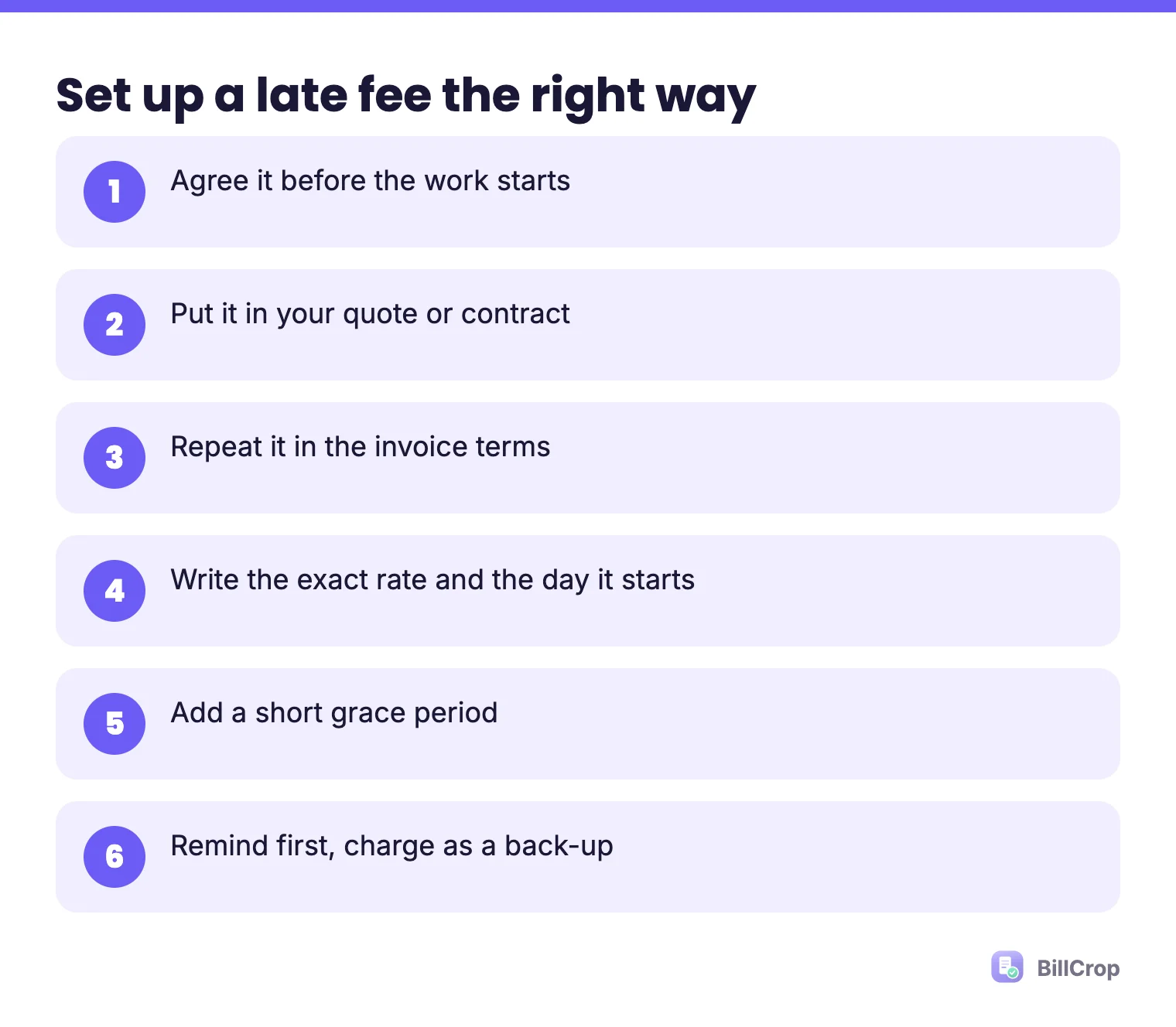
Put it in three places:
- Your quote or contract. Ask the client to sign or reply “approved”.
- Your invoice terms. Write it again at the bottom of each invoice.
- Your first message. Mention it once in plain words. “Invoices are due in 14 days.”
What should a late fee clause say?
Be exact. Say the number and the day. “Late fees may apply” is weak.
Payment is due within 14 days of the invoice date.
Invoices not paid by the due date will have a late fee of
[2]% of the unpaid amount for each month they stay unpaid.
Or a flat fee:
A late fee of [₦5,000] applies to invoices paid more than
[5] days after the due date.
A short grace period of a few days is a kind touch.
Should I charge a flat fee or a percentage?
A flat fee is simple and suits small invoices. A percentage grows with the bill, so it suits bigger ones. You can also mix them: a small flat fee, then a monthly percentage.
Pick one, and use it the same way for every client. Fees that change from client to client feel random and start arguments.
How do I work out the late fee amount?
Take the unpaid amount and multiply by the rate.
Example: a ₦150,000 invoice, 2% per month, one month late. ₦150,000 x 0.02 = ₦3,000.
Two months late at the same rate would be ₦3,000 x 2 = ₦6,000, if your terms say the fee repeats each month. Say clearly in your terms if it repeats. Our free late payment calculator does this for any rate and number of days.
How much is too much?
Keep it fair. A fee that looks like a punishment may not be enforceable, and some places set limits on late fees and interest. Rules differ by country and state, so check where you and your client are. If you use the same clause for every client, it is worth having a lawyer read it once.
What works better than a fee?
For most clients, a friendly reminder beats a fee.
- Send the first reminder the day after the due date. Our reminder messages are ready to copy.
- Follow the steps in how to chase unpaid invoices.
- Make it easy to pay. A pay link beats a bank account number.
- Use a short due date. See net 30 payment terms explained.
Should I waive a late fee?
You can, and sometimes it is smart. A good client who pays two days late may not deserve a fee. Be consistent: if you waive it, tell them it is a one-time kindness and that the terms still stand.
What should I say when I charge the fee?
Stay calm, name the invoice and quote your own terms.
Hi [Name], invoice [#014] was due on [22 October] and is now
[10] days late. As agreed in our terms, a late fee of [₦3,000]
has been added. New total: [₦153,000]. Pay here: [pay link]
Then send a revised invoice that shows the original amount, the fee and the new total. For retainer clients, the same clause fits in your recurring invoice agreement.
What if the client says they never agreed to the fee?
Show them where they agreed, and if there is none, drop the fee and fix your process. Check your quote, contract and earlier messages. If nothing is written down, it is hard to enforce. Waive it politely, ask for the base amount, and add the fee clause to every quote from now on.
How can BillCrop help?
BillCrop puts an online pay link on every invoice and lets you send a reminder on an overdue one in one click. So you can chase fast and still get paid. Start your 14-day trial.
This is general information, not legal advice.
Work out the interest or fee on an overdue invoice in seconds.
Free late payment calculator →